
Introduction to ACLS and Its Critical Role
ACLS, developed by the American Heart Association (AHA), is a set of clinical guidelines for the urgent treatment of life-threatening cardiovascular conditions, such as cardiac arrest, acute arrhythmias, and stroke. It extends Basic Life Support (BLS) by incorporating advanced procedures, medications, and team dynamics, making it essential for healthcare providers in emergency settings. The importance of ACLS is underscored by statistics: over 350,000 out-of-hospital cardiac arrests occur annually in the U.S., with survival rates around 10%, and in-hospital arrests show slightly better outcomes, but every minute without intervention reduces survival odds by 7-10% (Heart Disease and Stroke Statistics—2019 Update). Studies, such as one published in Resuscitation, highlight that adherence to ACLS protocols significantly improves return of spontaneous circulation (ROSC), with a 96% probability of ROSC with 0-2 deviations per event, dropping to 11% with more than 6 deviations (The association between ACLS guideline deviations and outcomes from in-hospital cardiac arrest).
For medical professionals, ACLS is not merely procedural; it involves understanding the “Hs and Ts” (hypovolemia, hypoxia, hydrogen ion [acidosis], hyper-/hypokalemia, hypothermia, tension pneumothorax, tamponade, toxins, thrombosis), which guide differential diagnosis during resuscitation, turning chaotic scenarios into structured responses.
Key Components of ACLS Training
ACLS training is a rigorous process, typically requiring renewal every two years, and includes several core components:
- Rhythm Recognition: Identifying and differentiating rhythms such as sinus bradycardia, third-degree AV block, ventricular fibrillation (VF), and pulseless ventricular tachycardia (VT) on ECG strips, crucial for timely intervention.
- Algorithm Mastery: Memorizing and applying algorithms for bradycardia, tachycardia with pulses, and cardiac arrest scenarios, such as VF/VT versus pulseless electrical activity (PEA)/asystole, ensuring standardized care.
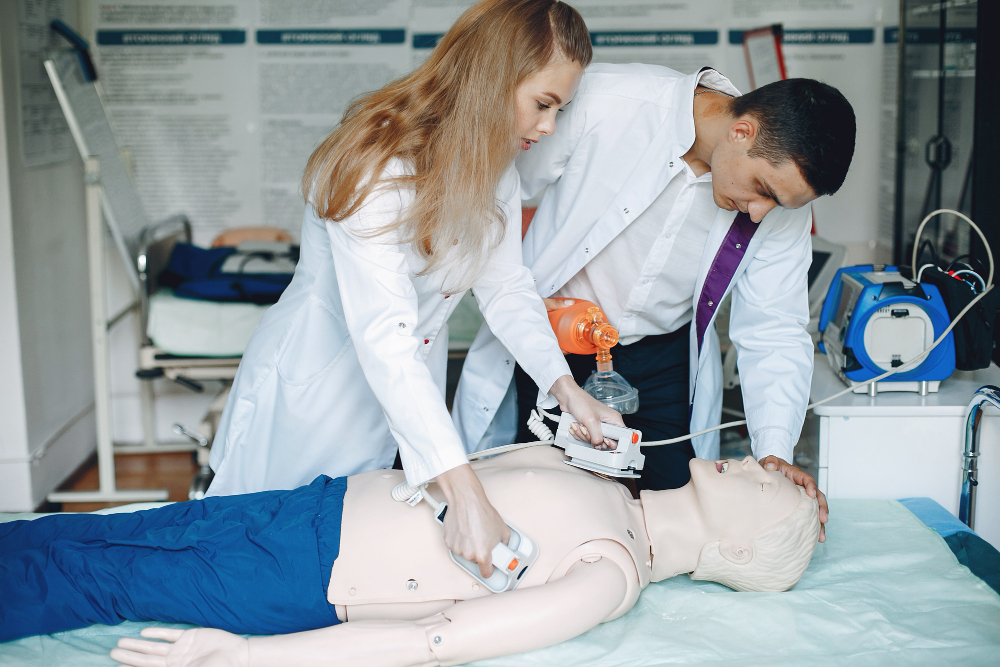
- Simulation: High-fidelity scenarios that mimic real-world codes, testing both technical skills (e.g., defibrillation, intubation) and communication, preparing providers for high-pressure environments.
- Post-Cardiac Arrest Care: Managing return of spontaneous circulation (ROSC) with targeted temperature management, hemodynamic optimization, and multimodal neuroprognostication, critical for long-term patient outcomes.
- Airway Management: Advanced techniques like endotracheal intubation or supraglottic airway devices, ensuring effective oxygenation during resuscitation.
- Pharmacology: Administration of medications such as epinephrine (1 mg every 3-5 minutes for non-shockable rhythms), amiodarone, adenosine, and others, with training on indications, contraindications, and timing.
- Team Dynamics: Emphasizing coordinated roles (e.g., compressor, airway manager, team leader) to minimize errors and maximize efficiency, especially in code blue situations.
Latest Updates in ACLS Guidelines
The AHA updates ACLS guidelines approximately every five years, with the latest major update in October 2020, valid until 2025, and a focused update in 2023. Key changes include:
- Early Epinephrine: Stronger emphasis on administering 1 mg every 3-5 minutes in non-shockable rhythms (PEA/asystole), supported by survival data, classified as Class 1 recommendation (2023 AHA Focused Update on Adult ACLS: Key Points).
- Feedback Devices: Encouraging real-time feedback tools to optimize CPR quality, ensuring compression depth (5-6 cm, 100-120/min) and minimizing interruptions.
- Post-Arrest Care: Enhanced focus on targeted temperature management and multimodal neuroprognostication, with a shift to using “temperature control” terminology instead of “targeted temperature management” (32-36°C)
- Medication Use: Vasopressin alone or with methylprednisolone may be considered in cardiac arrest (Class 2b), but is not a substitute for epinephrine (Class 2b).
- Capnography: Use to confirm tube placement and monitor CPR effectiveness (target ETCO2 >10 mmHg).
These updates ensure providers are equipped with evidence-based practices, though some aspects, like medication choices, remain controversial due to varying study outcomes.
Real-World Applications and Challenges
In practice, ACLS is applied in diverse settings, such as emergency departments, intensive care units, and pre-hospital care, where medical professionals face unique challenges:
- Complex Patients: A 60-year-old with VF might have an occult STEMI, or PEA arrest could stem from a massive pulmonary embolism (PE), requiring rapid differential diagnosis and adaptation of protocols.
- Resource Limitations: In rural settings, limited access to advanced equipment like defibrillators or monitors can hinder care, necessitating improvisation while adhering to guidelines.
- High-Pressure Environments: Adrenaline surges can cloud judgment, with studies showing clinicians may miss steps like pulse checks post-defibrillation, emphasizing the need for simulation and debriefing (The association between ACLS guideline deviations and outcomes from in-hospital cardiac arrest).
- Team Coordination: Ensuring smooth communication and role allocation during a code blue is critical, especially in crowded ERs, where noise and chaos can disrupt teamwork.
Continuous training and practice are essential to maintain proficiency, with simulation and feedback devices playing a key role in bridging textbook knowledge to muscle memory. Additionally, technology, such as automated external defibrillators (AEDs) and monitors, enhances resuscitation efforts, particularly in out-of-hospital cardiac arrests.
| Component | Description |
| Rhythm Recognition | Identifying VF, VT, bradycardia, and other rhythms on ECG for timely intervention |
| Algorithm Mastery | Memorizing pathways for cardiac arrest, bradycardia, and tachycardia management. |
| Simulation | High-fidelity scenarios testing technical skills and team communication. |
| Post-Arrest Care | Managing ROSC with temperature control and hemodynamic optimization. |
| Pharmacology | Administering drugs like epinephrine, amiodarone, with focus on timing. |
2020/2023 Updates | Early epinephrine, feedback devices, enhanced post-arrest care, debated meds. |
In conclusion, ACLS is a vital tool for medical professionals, offering a structured approach to managing cardiovascular emergencies. By understanding its components, staying updated with guidelines, and addressing real-world challenges, providers can significantly impact patient outcomes, ensuring they are prepared for the most critical moments.
ACLS Algorithm can be found here ACLS-algorithm